
Escolha o melhor suplemento de magnésio para seus objetivos de saúde
Table of Contents
- Key Takeaways
- Why not all magnesium is created equal
- Understanding supplement labels: Elemental magnesium and absorption
- Matching magnesium forms to your health goals
- Quality, safety, and getting the most from your supplement
- The truth most people miss about magnesium supplements
- Find the right magnesium formula for your wellness journey
TL;DR:
- The form of magnesium determines its bioavailability and effectiveness, not just the dosage.
- Chelated forms like glycinate and malate are best suited for absorption and targeted health goals.
- Always check for third-party certification and focus on elemental magnesium content on labels.
Most people assume that grabbing any magnesium supplement off the shelf will do the job. It won’t. The form of magnesium matters enormously, and choosing the wrong one can mean your body absorbs almost none of what you paid for. With dozens of formulas competing for your attention, from oxide to glycinate to L-threonate, the choice feels needlessly complicated. It doesn’t have to be. This guide walks you through a practical five-step decision process so you can stop guessing and start choosing a magnesium supplement that actually works for your specific goals.
Key Takeaways
| Point | Details |
|---|---|
| Form over dosage | The type of magnesium determines effectiveness far more than the listed milligrams. |
| Check absorption not label weight | Prioritise the amount your body actually absorbs, not just the highest number on the label. |
| Match to your goal | Choose a magnesium form based on your specific health target, such as sleep or cognition. |
| Prioritise quality and safety | Look for third-party tested, bioavailable formulas, and wise dosing for optimal benefits. |
Why not all magnesium is created equal
Here’s the part that most supplement labels won’t tell you clearly: the form of magnesium in your capsule determines how much your body actually uses. This is called bioavailability, meaning the proportion of a nutrient that enters circulation and has an active effect. A supplement with a high milligram count on the front label can deliver far less usable magnesium than a smaller-dose product in a better form.
Understanding why magnesium form matters is the single most important step before buying. Chelated organic forms, where magnesium is bound to an amino acid or organic acid, are absorbed significantly better than inorganic salts. A comparison of magnesium types shows that the differences are not minor.
Chelated forms absorb far better than inorganic forms: glycinate achieves over 80% absorption, citrate sits between 50 and 80%, while magnesium oxide delivers a mere 4% absorption rate.
Here’s what that means in practice:
- Magnesium glycinate: highest absorption, best for sleep and stress
- Magnesium citrate: good absorption, often used for general supplementation and digestion
- Magnesium malate: well absorbed, suited to energy and muscle recovery
- Magnesium L-threonate: crosses the blood-brain barrier, targeted at cognitive support
- Magnesium oxide: very low absorption, primarily used as a short-term laxative
Bioavailability trumps high elemental percentage. 200mg of glycinate delivers more usable magnesium than 400mg of oxide.
The takeaway is simple: don’t be seduced by the biggest number on the front of the packet. Now that you understand why a magnesium tablet isn’t just a magnesium tablet, let’s clarify how to decode those label claims.
Understanding supplement labels: Elemental magnesium and absorption
Label reading skill is essential, especially when numbers can be deceptive. When you pick up a magnesium supplement, the milligram figure on the front usually refers to the total weight of the compound, not the actual magnesium your body receives. The figure you need is the elemental magnesium content, which is typically listed in the supplement facts panel on the back.
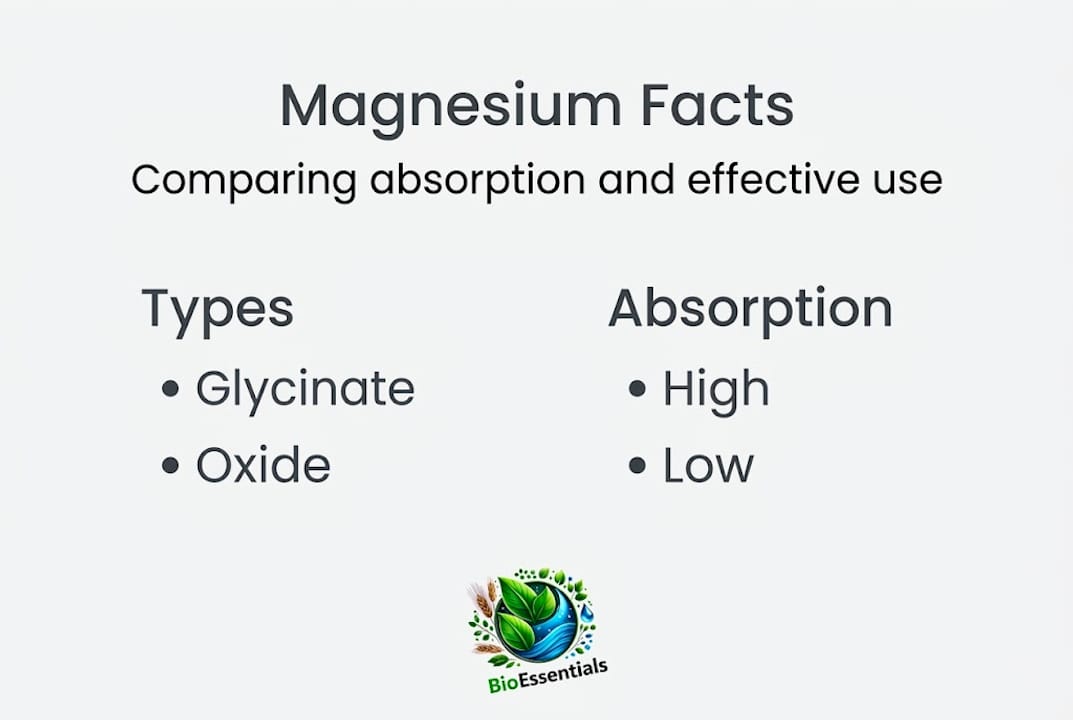
This distinction matters because different magnesium compounds contain very different proportions of actual magnesium. Always check elemental magnesium on labels rather than total compound weight: oxide is 60% elemental but its low absorption yields roughly 2.4mg usable per 100mg, whereas glycinate is only 14% elemental but delivers approximately 11.2mg usable per 100mg.
The table below makes this concrete:
| Form | Elemental Mg (%) | Typical absorption (%) | Usable Mg per 100mg |
|---|---|---|---|
| Magnesium oxide | 60% | ~4% | ~2.4mg |
| Magnesium glycinate | 14% | ~80%+ | ~11.2mg |
| Magnesium citrate | 16% | ~50-80% | ~8-12.8mg |
| Magnesium malate | 15% | ~60-70% | ~9-10.5mg |
| Magnesium L-threonate | 8% | ~70%+ | ~5.6mg+ |
The oxide column is striking. A product boasting 500mg of magnesium oxide sounds impressive until you realise your body absorbs roughly 20mg of that. A glycinate product at 200mg delivers far more where it counts.

When choosing supplements for health, always flip to the back panel and look for the elemental magnesium figure specifically. If the label doesn’t show it, that’s a warning sign.
Pro Tip: Don’t be swayed by high milligram claims on the front. The number that matters is the usable elemental magnesium after absorption, not the total compound weight.
Matching magnesium forms to your health goals
Once you know what to look for on labels, the next step is tailoring your choice to your specific needs. Not every form of magnesium suits every goal, and picking the right match is where you’ll see a real difference.
Start by identifying your primary goal from this list:
- Sleep and relaxation: difficulty falling asleep, nighttime restlessness, anxiety
- Energy and vitality: afternoon fatigue, low stamina, general tiredness
- Muscle recovery: post-exercise soreness, cramps, physical training support
- Cognitive support: focus, memory, mental clarity
- Broad wellness: general magnesium repletion, bone health, cardiovascular support
Once you’ve identified your goal, use this decision table:
| Wellness goal | Best magnesium form | What to look for on the label |
|---|---|---|
| Sleep and relaxation | Glycinate | “Magnesium bisglycinate” or “glycinate”, chelated |
| Energy and vitality | Malate | “Magnesium malate”, malic acid complex |
| Muscle recovery | Malate or citrate | Chelated, no oxide fillers |
| Cognitive support | L-threonate | “Magtein®” or “L-threonate”, brain-targeted |
| Broad wellness | Multi-form blend | Five or more forms, third-party tested |
The evidence behind these matches is solid. L-threonate for cognition is backed by research showing it uniquely crosses the blood-brain barrier, which other forms cannot do. For sleep, glycinate’s calming effect comes from the glycine component itself, which supports neurotransmitter balance.
For those who want complete coverage without having to pick just one form, a multi-form product like MAGNESIUM 5® combines glycinate, malate, citrate, L-threonate, and taurate in a single formula. It’s the practical answer for anyone who doesn’t want to juggle multiple bottles.
Symptom-specific magnesium advice consistently reinforces that matching form to function outperforms taking any single high-dose generic product. Third-party tested forms with chelated, bioavailable compounds, taken with meals if non-chelated, and split across doses, represent best practice.
Quality, safety, and getting the most from your supplement
Having matched magnesium forms to your needs, it’s crucial to ensure safety, quality, and proper use for the greatest benefit. A well-chosen form in a poorly manufactured product is still a poor choice.
Follow these five steps for safe, effective supplementation:
- Choose third-party tested products. Look for USP or NSF certification on the label. These independent bodies verify that what’s on the label is actually in the capsule, at the stated dose, without harmful contaminants. Check certifications and quality standards before purchasing.
- Prioritise chelated or bioavailable forms. Eliminate oxide from consideration for daily magnesium needs. It simply doesn’t deliver enough usable magnesium to justify the cost.
- Check for unnecessary fillers and binders. Some products pad their capsules with magnesium stearate, silicon dioxide, or artificial colourants. These add nothing to your health and may reduce absorption. A clean ingredient list is a quality signal.
- Split your daily dose. Rather than taking 400mg in one go, split it into two doses of 200mg. This improves optimising supplement absorption because the gut has a limited transport capacity at any one time.
- Consult your doctor if you take medication. Magnesium interacts with certain antibiotics, diuretics, and blood pressure medicines. This isn’t a reason to avoid it, but it is a reason to check first.
Also consider supplement delivery formats. Capsules generally outperform tablets for absorption speed. Powders dissolved in water can work well for citrate forms. Topical magnesium (sprays or oils) is sometimes used for localised muscle relief, though systemic absorption via skin remains limited according to current magnesium absorption facts.
Pro Tip: If you’re using a non-chelated form like citrate, take it with a meal to reduce the chance of digestive discomfort and improve uptake. Chelated forms like glycinate are gentler and can be taken any time.
The truth most people miss about magnesium supplements
After years of watching people navigate the supplement aisle, one pattern stands out: the biggest mistake isn’t choosing the wrong form. It’s assuming that a higher milligram number means better results. Marketing has done a thorough job of conditioning people to equate size with efficacy.
The reality is that a 100mg glycinate capsule from a reputable, third-party tested brand will outperform a 500mg oxide tablet from a budget manufacturer every single time. The numbers on the front of the packet are largely irrelevant without knowing the form and absorption rate behind them.
We’d also argue that trying to solve a specific health goal with a single-form, generic magnesium product is an oversimplification. Sleep, energy, muscle recovery, and cognitive function all draw on magnesium through different pathways. A product designed with multiple bioavailable forms addresses this more intelligently than any single-form solution.
The single most important action you can take is to read the supplement facts panel, not the front label. That’s where the real information lives.
Find the right magnesium formula for your wellness journey
If you’ve worked through the five steps above and you’re ready to act, BioEssentials offers science-backed, highly bioavailable magnesium options that tick every box: chelated forms, third-party tested, no unnecessary fillers, and formulated for specific wellness goals.

For those seeking broader cognitive and recovery support alongside their magnesium routine, explore the science-backed cognitive formula that pairs well with a well-designed magnesium protocol. Whether you’re starting fresh or upgrading from a generic product, shop BioEssentials supplements to find formulas built around what your body actually absorbs.
Frequently asked questions
Which magnesium form is best for sleep support?
Magnesium glycinate is widely recommended for sleep because its 80%+ absorption rate and the calming properties of glycine make it the most effective option for relaxation and restful nights.
How can I tell if a magnesium supplement is high quality?
Look for USP or NSF third-party certification on the label, choose chelated or bioavailable forms, and check that the ingredient list is free from unnecessary fillers or binders.
Is magnesium oxide effective for daily magnesium needs?
No. Magnesium oxide has roughly 4% absorption and is far better suited as a short-term laxative than as a reliable way to raise your magnesium levels.
What is the safest way to take magnesium supplements?
Take magnesium with food if using non-chelated forms, split your daily dose into two smaller amounts, and consult your doctor before combining it with any prescription medication.
Recommended
- How to choose an immunity mushroom supplement: 5 criteria — BioEssentials
- How to choose the right magnesium supplement: the 5-form buyer's guide — BioEssentials
- Multi-pathway liver support: the new standard — BioEssentials
- How to choose a focus supplement: 5 expert criteria — BioEssentials
- Metabolic flexibility: why blood sugar matters more than calories — BioEssentials
Our research and formulas have been recognized by leading media outlets such as Marie Claire.
Scientific References
- Clinical evidence on Magnesium efficacy and safety (PubMed)
- Mechanisms of action and bioavailability of Magnesium (PMC)
- Evidence-based review: Magnesium supplementation outcomes (PubMed)
These statements have not been evaluated by the Food and Drug Administration. BioEssentials products are food supplements intended to support general wellness and daily nutritional needs. They are not intended to diagnose, treat, cure, or prevent any disease. Always consult a healthcare professional before starting any new supplement if you are pregnant, breastfeeding, taking medication, or managing a health condition.


