
Dlaczego forma magnezu ma większe znaczenie dla zdrowia niż dawka
Table of Contents
- Key Takeaways
- Understanding magnesium: forms, functions, and absorption
- Why dose on the label can mislead you
- Choosing the right magnesium: goals, forms, and individual needs
- How to avoid common mistakes when selecting magnesium supplements
- What most supplement shoppers still get wrong about magnesium
- Support your well-being with premium magnesium blends
TL;DR:
- Bioavailability of magnesium forms is more important than the total dose for effective supplementation. Different magnesium types serve various health functions and vary significantly in absorption rates. Using a combination of well-absorbed forms provides comprehensive support for sleep, cognition, energy, and overall well-being.
A 500 mg dose of magnesium oxide delivers less usable magnesium to your cells than 150 mg of magnesium bisglycinate. That single fact overturns how most people shop for supplements. The number printed on the bottle is not the whole story. What actually reaches your bloodstream, your muscles, and your brain depends almost entirely on theformof magnesium you are taking. In this guide, we will walk through why bioavailability is the real measure of a supplement’s power, which forms perform best, and how to match your choice to your actual health goals rather than the largest milligram count on the shelf.
Key Takeaways
| Point | Details |
|---|---|
| Form trumps dose | The magnesium type you choose has more impact on benefits than the milligram count alone. |
| Absorption is critical | Choose well-absorbed magnesium forms for your health goal to maximise effectiveness. |
| Check for quality | Verify supplement certification and form to avoid wasting money on poorly absorbed pills. |
| Personalise your choice | Match your supplement’s form to your specific needs, such as sleep, digestion, or cognitive health. |
| Avoid common mistakes | Don’t rely on label dose alone—review form, delivery method, and brand trust. |
Understanding magnesium: forms, functions, and absorption
Magnesium is involved in over 300 enzymatic reactions in the human body. It supports healthy muscle contraction and relaxation, regulates nerve signalling, helps convert food into cellular energy, and plays a direct role in sleep quality by activating calming neurotransmitters. Put simply, without adequate magnesium, your body cannot function at its best.
Yet most people who take magnesium supplements never think about the form they are buying. They see a high milligram count, assume more is better, and add it to their basket. The problem is that nutrient absorption and bioavailability vary...
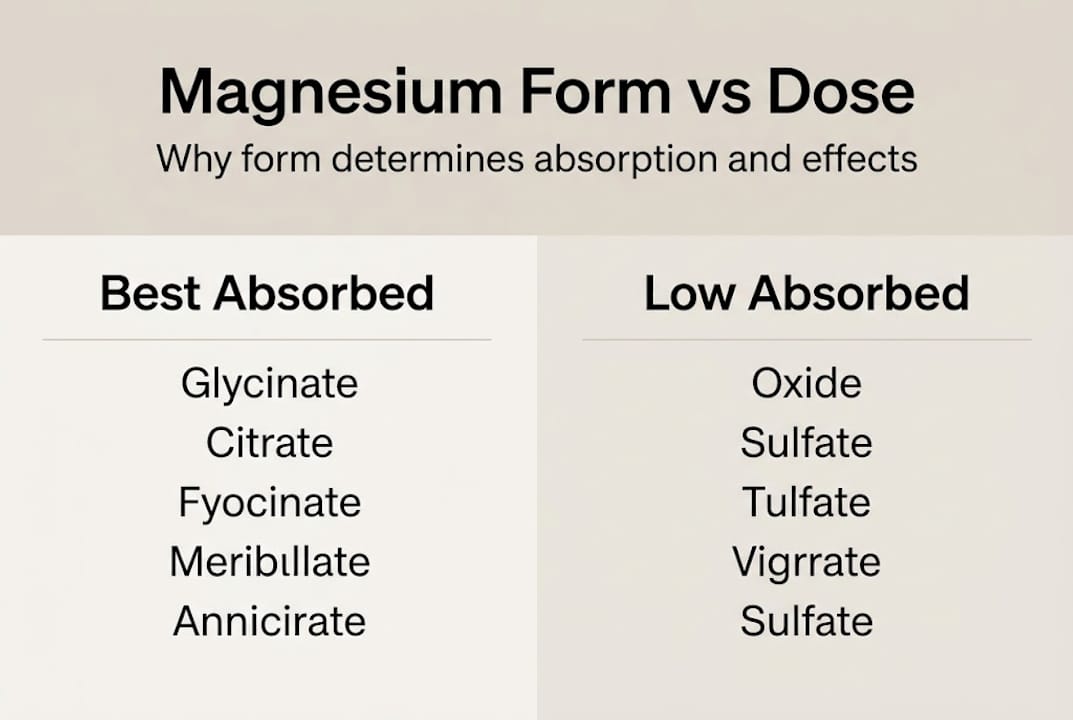
Different magnesium forms are absorbed and used differently by the body, which is why choosing wisely matters far more than chasing a higher milligram count.
The most common forms you will encounter include:
- Magnesium oxide: High in elemental magnesium but very poorly absorbed. Commonly used as a laxative.
- Magnesium citrate: Bound to citric acid. Good absorption and widely available.
- Magnesium glycinate (bisglycinate): Bound to glycine, an amino acid. Excellent absorption and gentle on the digestive system.
- Magnesium L-threonate: A newer form that has shown a unique ability to cross the blood-brain barrier, making it particularly interesting for cognitive support.
- Magnesium malate: Bound to malic acid. Valued for energy support and muscle comfort.
Here is a quick overview of how these forms compare:
| Form | Approximate absorption | Primary use |
|---|---|---|
| Magnesium oxide | Very low (4%) | Laxative use |
| Magnesium citrate | Moderate (25-30%) | General supplementation |
| Magnesium glycinate | High (up to 80%) | Sleep, relaxation, daily use |
| Magnesium L-threonate | High (targeted) | Brain health, cognition |
| Magnesium malate | High | Energy, muscle recovery |
Exploring the range of magnesium forms for wellness can...
Pro Tip: Never buy a magnesium supplement based on the total milligrams alone. Check the form first, because a well-absorbed form at a lower dose will consistently outperform a poorly absorbed form at a higher dose.
Why dose on the label can mislead you
Imagine purchasing a supplement labelled “400 mg magnesium” and feeling confident you are covering your daily needs. In reality, if that product contains magnesium oxide, your body may only absorb around 16 mg of that. The rest passes through your digestive system without reaching your cells at all.
This is not a minor technicality. It is a fundamental issue with how supplements are marketed. Manufacturers are not obligated to highlight bioavailability on the label, so the milligram figure dominates. Consumers naturally assume that a 500 mg product is superior to a 200 mg product. But a higher magnesium dose does...
Here is a direct comparison to illustrate the point:
| Form | Label dose | Estimated absorbed amount |
|---|---|---|
| Magnesium oxide | 400 mg | ~16 mg |
| Magnesium citrate | 400 mg | ~100-120 mg |
| Magnesium glycinate | 200 mg | ~160 mg |
Magnesium glycinate at half the stated dose can deliver ten times the usable magnesium compared with oxide. That is not a minor improvement. That is a completely different supplement in terms of real-world impact.
It is also worth checking supplement safety guidelines before assuming...
“Quality of form will always outweigh quantity of dose. The most sophisticated supplement choices start not with the milligrams but with the molecule that carries them.”
When choosing effective supplements, prioritise the form and the evidence behind it. The label dose tells you what is in the capsule. It tells you nothing about what reaches your cells.

Choosing the right magnesium: goals, forms, and individual needs
Selecting a magnesium supplement should...
Here is a goal-based guide to help you match form to need:
- Sleep and relaxation: Magnesium glycinate is the top choice. Glycine itself has calming properties, and the compound is gentle on the stomach, making it ideal for evening use.
- Cognitive support and brain health: Magnesium L-threonate is the only form shown to meaningfully raise magnesium concentrations in the brain. Explore the evidence on magnesium for cognition if mental...
- Energy and muscle recovery: Magnesium malate supports the production of ATP, the energy currency of your cells, and may ease post-exercise muscle soreness.
- Digestive support or occasional constipation: Magnesium citrate can be helpful here, though oxide is sometimes used for this purpose as well due to its low absorption causing a drawing effect in the gut.
- Everyday general use: A blend of well-absorbed forms provides the broadest coverage across all body systems.
Before you start, be aware of a few cautions:
- High doses of any magnesium form can cause loose stools or stomach cramps, particularly in sensitive individuals.
- Those with kidney conditions should consult a healthcare professional before supplementing, as the kidneys regulate magnesium excretion.
- Some medications interact with magnesium, including certain antibiotics and diuretics.
- Starting with a lower dose and building up gradually helps your body adjust.
Using supplement synergy tips can also help you understand how magnesium works alongside other nutrients such as vitamin D, B6, and zinc for more complete support.
Pro Tip: Instead of choosing just one form, consider a multi-form product. Stacking glycinate for sleep, threonate for cognition, and malate for energy in one daily supplement covers far more ground than any single-form product ever could.
How to avoid common mistakes when selecting magnesium supplements
Even well-informed supplement buyers make avoidable errors when shopping for magnesium. Knowing what to look for, and what to ignore, protects both your wallet and your health outcomes.
The most common pitfalls include fixating on total milligrams without checking the form, ignoring third-party testing, and overlooking the delivery method. Checking supplement quality certifications and...
Here is a practical checklist for assessing any magnesium supplement:
- Check the form first: Look for glycinate, malate, citrate, or threonate. Avoid products that list only “magnesium oxide” unless you have a specific digestive need.
- Look for third-party testing: Reputable brands publish certificates of analysis from independent laboratories confirming potency and purity.
- Examine the ‘Other ingredients’ section: Avoid unnecessary fillers, synthetic binders, or artificial colourants that serve no health purpose.
- Verify the delivery type: Understanding supplement delivery types matters because...
- Check the serving size: Some products list impressive totals but spread them across four or six capsules per day, making daily compliance difficult.
- Avoid proprietary blends with hidden ratios: If the product does not disclose how much of each form is present, you cannot judge its actual effectiveness.
Pro Tip: Read the ingredient list from bottom to top. Manufacturers often bury inferior or unnecessary ingredients towards the end of the list, but they still affect what you are putting into your body.
Being a discerning buyer is not about distrust. It is about applying the same logic to supplementation that you would apply to any other investment in your well-being.
What most supplement shoppers still get wrong about magnesium
After years of working in the natural health space, one pattern stands out above all others: people obsess over dose and ignore synergy. They hunt for the largest number, the cheapest price, or the most dramatic marketing claim. They rarely ask which forms are included or whether the delivery method allows for proper absorption.
The uncomfortable truth is that the budget magnesium product with 500 mg of oxide is almost certainly performing worse than a thoughtfully formulated 200 mg glycinate blend, even if it costs twice as much per bottle. Cheapest rarely means best when bioavailability is factored in.
What advanced supplement users understand is that a multi-form magnesium approach addresses the body as a whole system. Sleep, cognition, energy, muscle function, and cardiovascular health all draw on magnesium differently. No single form covers every pathway. The most intelligent strategy is not to pick one winner but to use several complementary forms together, each doing what it does best.
When you think about magnesium this way, the question shifts entirely. You stop asking “how many milligrams?” and start asking “which forms, in what combination, delivered how?” That shift in thinking is the difference between supplementing and genuinely supporting your health.
Support your well-being with premium magnesium blends
Putting this knowledge into practice means looking beyond the label milligrams and seeking out formulations built around genuine bioavailability. At BioEssentials, we have designed our supplements around exactly this principle.

Our flagship MAGNESIUM 5® brings together five clinically researched forms in a single product, glycinate, threonate, malate, citrate, and taurate, so you are not forced to choose just one benefit. Rather than guessing which form suits you, you get complete coverage. Browse the full BioEssentials range to find formulations...premium magnesium blend and see what genuine bioavailability feels like.
Frequently asked questions
Which magnesium form is the most easily absorbed?
Magnesium glycinate and citrate have higher absorption rates than oxide and are suitable for most people seeking daily magnesium support.
Is it safe to take high-dose magnesium supplements?
High doses can cause side effects including digestive discomfort; excessive magnesium intake should be avoided without guidance from a health professional, particularly if you have kidney concerns.
How can I tell if a magnesium supplement is good quality?
Look for third-party certification, transparent form labelling, and a clean ingredient list. Certifications ensure supplement quality and confirm that what is on the label is actually in the bottle.
Can I combine different magnesium forms for better results?
Yes. Combining multiple magnesium forms can help target several health goals at once, from sleep and relaxation to energy and cognitive clarity, offering broader benefits than any single form alone.
Recommended
- Sleep supplements: why the best go beyond melatonin — BioEssentials
- How to choose a myo-inositol supplement: 5 criteria — BioEssentials
- How to choose a daily energy supplement: 5 criteria — BioEssentials
- How to stack magnesium: 5 BioEssentials formulas explained — BioEssentials
- Metabolic flexibility: why blood sugar matters more than calories — BioEssentials
Our research and formulas have been recognized by leading media outlets such as Marie Claire.
Scientific References
- Clinical evidence on Magnesium efficacy and safety (PubMed)
- Mechanisms of action and bioavailability of Magnesium (PMC)
- Evidence-based review: Magnesium supplementation outcomes (PubMed)
These statements have not been evaluated by the Food and Drug Administration. BioEssentials products are food supplements intended to support general wellness and daily nutritional needs. They are not intended to diagnose, treat, cure, or prevent any disease. Always consult a healthcare professional before starting any new supplement if you are pregnant, breastfeeding, taking medication, or managing a health condition.


